
AI Search Is Not a Shortcut
AI search is not a shortcut. It is SEO maturing.
There is a lot of noise right now around AI search, AEO (Answer Engine Optimization), and the latest attempts to rebrand fundamentals as something new. Much of this advice implies that SEO stopped working and that AEO is a completely separate discipline.
What bothers me about most of this thinking is that it is SEO fundamentals, brand, and product quality wrapped in AEO language and sold as a breakthrough. Overcomplicating this does not help businesses make better decisions.
AI search is changing how recommendations are delivered, not why certain brands get recommended.
Google Ranks Pages. AI Recommends Brands.
In Google search, people compare. In AI search, people decide. The same query can lead to very different outcomes depending on whether the answer comes from a results page or an AI response.
SEO still matters. AEO sits on top of it. AEO is how your SEO work translates into trust, recognition, and recommendation inside AI systems. Without solid SEO fundamentals, AEO has nothing to stand on.
At Google Search Live in Zurich, Google’s Senior Search Analyst John Mueller put it clearly:
“AI systems rely on search. and there is no such thing as GEO or AEO without doing SEO fundamentals.
Tricks will come out and they will work for a short time, companies that want to be around for the long term should focus on something that is proven with long term stability and not tricks.”
Recognition Is the Foundation of AEO
If you want to improve AEO in 2026, the starting point is recognition, not keywords.
AI systems are not counting phrases. They are synthesizing signals to answer a question with confidence. AEO improves when it is clear who you are, what you do, and why you are a credible answer.
That clarity comes from:
- Writing like a human who understands the problem
- Publishing content that helps the buyer decide
- Consistent language around your services and positioning
- Proof that you deliver outcomes
This has always been good SEO. AEO simply rewards it more directly.
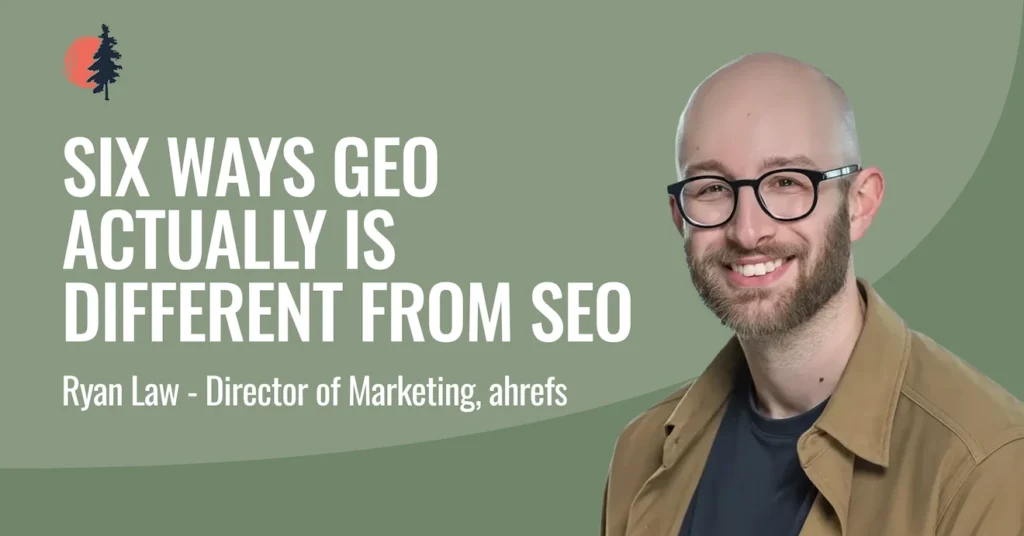
Ryan Law, Director of Marketing at ahrefs and who gained respect in the content world during his time at Animalz sums this up well:
“SIX ways GEO actually is different from SEO:
1. Unlinked brand mentions matter more. Unlinked text mentions can improve LLM visibility in a way that won’t benefit search visibility.
2. Off-topic links and content matter less. Backlinks from irrelevant sites with little relevant surrounding context help SEO but do little for LLM visibility. Same goes for off-topic content built just for traffic (“site reputation abuse”).
3. Some content types have relatively little impact on SEO visibility but greater impact on LLM visibility (e.g. PDF documents have a bigger impact on LLM visibility than search visibility; ecommerce listings pages have less).
4. LLMs benefit from unique document structures. There are ways to structure text that aid in LLM comprehension, and hence visibility, that won’t benefit search in the same way (e.g. “global document context”).
5. LLMs train on data that doesn’t typically improve search visibility, like public GitHub repos, knowledgebases, and code samples. “Optimisations” made to these data sources could improve LLM visibility without benefiting search.
6. LLMs don’t render JavaScript. AI crawlers currently can’t process client-side JavaScript, making JS-heavy content invisible to them for now. Your JS content can help search visibility with no impact on LLM visibility.”
Ryan makes a solid point here. GEO does behave differently in places, especially around unlinked mentions, content formats, and where AI systems source their data.
But in practice, these differences amplify good fundamentals rather than replace them. Brands with clear positioning and consistent signals still win.
Your Website Still Does the Heavy Lifting
AI systems pull answers from content that proves value quickly. Pages that consistently support AEO include:
- Case studies that show real outcomes
- FAQs that address decision-stage questions
- Comparison pages that clarify positioning
- Pricing pages that remove uncertainty
When these are missing, AEO suffers because AI systems cannot confidently recommend you.
AEO Is Built Off-Site Too
AI systems trust third-party validation more than self-promotion. Mentions across the web help establish whether your brand deserves to be named.
This includes:
- Industry blogs and publications
- Reddit, Quora, and forums
- Review platforms
- Roundups and comparison articles
Links help, but AEO is less about link attributes and more about consistent, credible mentions in relevant contexts.
Business Profile Hygiene Still Matters
Here’s a tightened version tucked neatly into that section, keeping it short and practical.
Every profile you control should be claimed and properly filled out:
- Google Business Profile and Bing Places
- LinkedIn company page and social profiles
- Review sites and industry directories
Accurate NAP citations (Name, Address, Phone) are still a fundamental. What matters more now is the About section. Keep it clear and consistent. State exactly what you do, who you serve, and where you operate in plain language. This is where AI systems often pull structured context for AEO, so clarity beats clever copy.
Reviews Continue to Influence AEO
AI tools regularly scan reviews to assess legitimacy, trust, and experience. Not just star ratings, but volume, recency, and language.
Businesses that build a simple, repeatable process to collect reviews tend to see faster gains in both traditional SEO and AEO visibility.
The Real Takeaway
AEO is not replacing SEO. It is exposing who invested in the fundamentals and who relied on shortcuts.
Strong positioning, clear messaging, real proof, and consistent visibility still win. The difference now is that instead of ranking a few spots lower, your brand may not be mentioned at all.
Next Steps
If you want a deeper look at the trust signals that underpin both SEO and AEO, we wrote this breakdown on Google E-E-A-T.
And if you are thinking about how SEO and AEO fit into your 2026 plans, a focused audit is often the clearest place to start. It helps identify which fundamentals are solid, where AI visibility is already forming, and what gaps are holding your brand back from being recommended. Contact Big Cedar today.