
A major Search Console change that reshapes how clicks and impressions are tracked, Google’s back-to-back updates, and AI Overviews cutting clicks.
Q3 2025 quietly changed how SEO performance is measured. Many businesses opened Google Search Console to find sharp drops in impressions, confusing trends, and data that no longer lined up with reality. Read on for this and notable changes affecting SEO and content through a small business lens.
1. Search Console Reporting Changed and Impressions Dropped Sharply
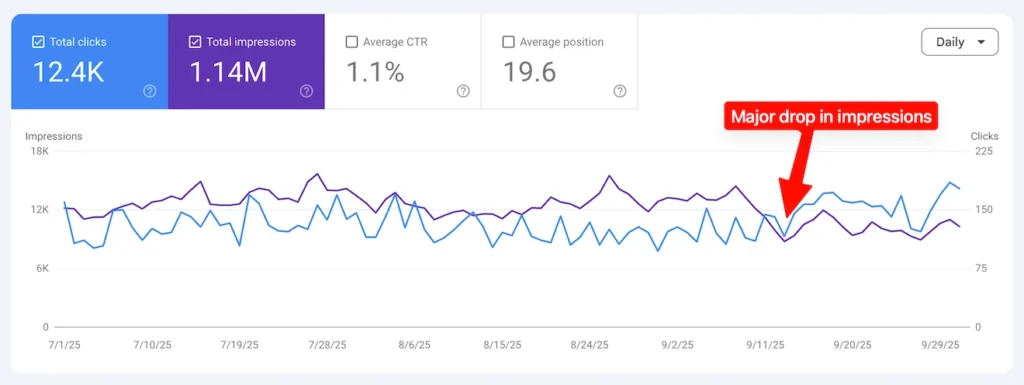
Many sites saw a noticeable drop in impressions in Google Search Console during Q3, even when rankings and traffic stayed relatively stable. This aligns with two overlapping shifts: Search Console’s query grouping changes and the ongoing rise of zero-click searches, where users get answers directly in Google without clicking through.
Here’s how the September drop looked for one of our larger clients. Notice how clicks actually went up over in that period of volatility, because of our strong SEO foundation and the quality of the content:
Zero-click behavior is now a structural part of search, not a temporary trend. Rand Fishkin explains why it matters in this 5-min video (with transcript): Why Do We Need Zero Click Marketing?
Applying This to Your Business:
- Treat impression drops in GSC as a reporting change, not an automatic performance issue
- Track clicks, leads, and revenue as primary KPIs instead of impressions
- Rewrite titles and introductions to clearly promise value beyond a quick answer
- Build demand for branded and local searches, which still drive clicks
2. Rank Tracking Looks More Volatile Than It Really Is
Google quietly removed the “100 results per page” option, forcing rank tracking tools like Ahrefs and Semrush to change how they measure visibility. This made short-term ranking swings look more dramatic, even when real-world traffic and leads didn’t move much.
Applying This to Your Business:
- Use weekly or monthly trends instead of daily rank checks
- Compare rankings against clicks and conversions before reacting
- Flag real issues only when rankings, traffic, and leads drop together
3. Back-to-Back Core and Spam Updates Reshuffled Results
A late-summer core update followed closely by a spam update caused widespread ranking changes across service businesses, local sites, and blogs. The hardest-hit sites weren’t broken technically. They had thin pages, over-optimized content, or questionable link profiles.
Applying This to Your Business:
- Prune pages that don’t clearly serve a search intent
- Simplify content that feels written for keywords instead of people
- Focus link-building on relevance and reputation, not volume
4. Google Search Console Now Groups Queries by Intent
Search Console began grouping similar queries together, reducing the visibility of individual keyword-level data. This reflects Google’s continued shift away from exact keywords and toward intent and topic relevance. The change sparked heavy discussion in SEO circles, including this breakdown:
Applying This to Your Business:
- Organize content around problems and solutions, not single phrases
- Strengthen one authoritative page per intent instead of many similar ones
- Use grouped query trends to spot content gaps and expansion opportunities
5. AI Overviews Continued to Reduce Organic Clicks
AI Overviews became more common in Q3, especially for informational searches on mobile. Many sites held their rankings but still lost traffic as answers were delivered directly in search results.
Applying This to Your Business:
- Prioritize service, comparison, and decision-stage content
- Add clear next steps, visuals, and local relevance AI summaries can’t replace
- Strengthen internal linking to guide users deeper once they land
6. Trust and Brand Signals Matter More Than Ever
Across organic listings, AI-generated answers, and SERP features, the same signals kept winning: clear business identity, real-world credibility, and strong UX. SEO discussions in Q3 consistently emphasized fundamentals over tactics or shortcuts.
Applying This to Your Business:
- Improve About pages, author attribution, and business details
- Remove outdated or low-value content that weakens trust
- Invest in a clean, fast, and easy-to-understand website experience
Next Steps to Improve Your SEO
Curious how your site measures up against Google’s latest algorithm changes? Want to leverage AI for smarter SEO while maximizing your conversion rates? Looking for a holistic strategy that turns traffic into revenue?
Big Cedar specializes in research that delivers actionable insights to boost your search rankings and transform visitors into clients. We combine data-driven SEO and GEO, analytics, and conversion rate optimization into one cohesive strategy that drives real business growth. Contact Big Cedar to find out how.